
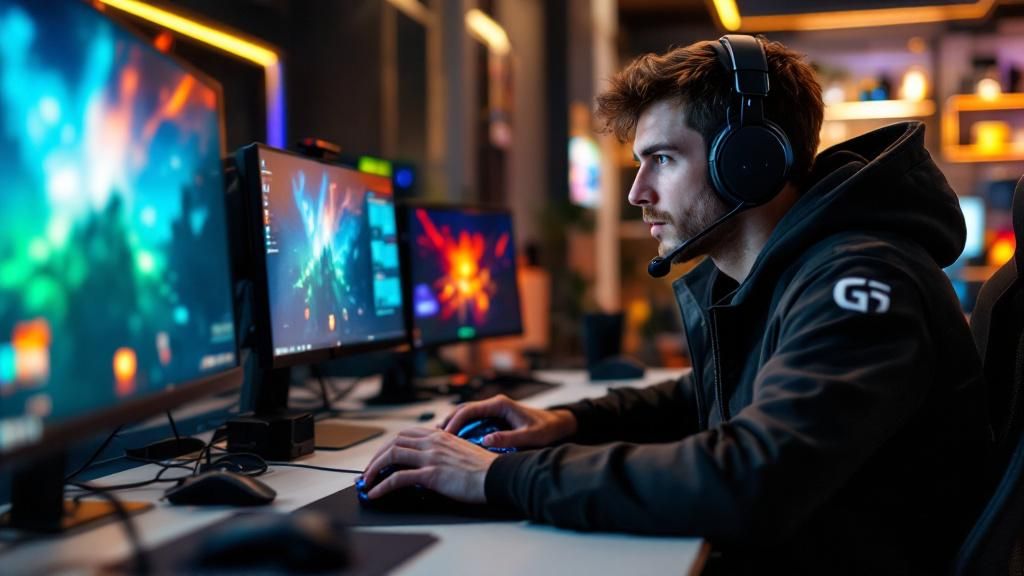
The competitive esports landscape in Britain has evolved dramatically, with established organisations investing considerably in cutting-edge technology to gain every conceivable advantage. From precision gaming mice to responsive key switches and premium visual equipment, the gear decisions can significantly influence their performance. In this guide, we investigate what top UK esports teams focus on when building their setups, identifying the specific equipment, system specifications, and comfort factors that distinguish elite players from the rest.
Professional Gaming Mice and Accurate Cursor Control
British esports teams recognise that a gaming mouse functions as the fundamental tool for competitive success, particularly in high-speed competitions necessitating immediate reflexes. Competitive gamers invest heavily in mice engineered specifically for esports, emphasising responsiveness and ergonomic design. The bond between athlete and device is paramount; teams undertake comprehensive trials to discover models that suit personal gaming preferences. Leading British organisations report that their squad participants often test various models before selecting their preferred setup, understanding that even marginal improvements in accuracy can translate to championship success.
The evolution of gaming mouse technology has brought forth sophisticated features that contemporary esports professionals now regard as essential. Lightweight designs decrease fatigue during extended competitive sessions, whilst customisable side buttons enhance accessibility to in-game commands. British teams emphasise that consistency matters considerably; players use identical mice across training and competitive environments to eliminate variables. Many organisations have established partnerships with peripheral manufacturers, enabling players exposure to prototype devices before commercial release, thereby maintaining their technological edge against overseas rivals.
Sensor Technology and DPI Configuration
Modern gaming mice employ advanced optical sensors able to tracking minute hand movements with extraordinary precision. British esports professionals configure their DPI settings in line with game-specific requirements and personal preference, with many maintaining multiple profiles for different titles. The relationship between sensitivity and mouse pad surface proves crucial; teams carefully optimise settings to ensure consistent performance across varying environments. Professional players often prefer reduced sensitivity paired with larger mouse pad surfaces, allowing for greater control during critical moments. This methodical approach to sensor optimisation reflects the meticulous preparation underpinning elite British esports organisations.
DPI customisation extends beyond simple sensitivity adjustments; advanced mice offer acceleration curves and angle snapping features that competitive players fine-tune extensively. British teams document their preferred configurations meticulously, creating detailed profiles for each player and title combination. Many professionals conduct regular sensitivity audits, reassessing their settings seasonally to maintain optimal performance. The psychological aspect of peripheral familiarity cannot be understated; players develop muscle memory aligned with specific DPI values, making consistency paramount|stability essential. Leading British organisations invest considerable time ensuring their rosters achieve perfect synchronisation between hardware capabilities and player preferences.
- Optical sensors track movements with precision at sub-millimetre levels consistently.
- DPI ranges generally range from 400 to 3200 for competitive play.
- Polling rates of 1000Hz provide reduced input latency during matches.
- Acceleration curves configuration boosts flick accuracy significantly.
- Mouse pad surface selection affects sensor tracking performance substantially.
Mechanical Keyboard Switches for Professional Edge
British esports professionals universally acknowledge mechanical keyboards as vital parts of their gaming setups. The physical response and swift activation these keyboards deliver directly contribute to improved reaction times and stability during demanding gameplay. Leading teams across various games invest substantially in top-tier mechanical switches, aware that fractional time reductions can determine match outcomes. The dependability and strength of mechanical components guarantee consistent performance steadily across intensive tournament circuits and practice routines.
The selection of mechanical input device transcends mere preference; it signifies a deliberate commitment in competitive advantage. Teams undertake comprehensive evaluation to identify switches matching their approach and gaming needs. Whether participating in fast-paced shooters or strategy-based titles, British esports teams prioritise keyboards providing customisable actuation points and response profiles. Professional players report tangible performance enhancements after transitioning to quality mechanical keyboards, attributing enhanced accuracy and faster execution to high-grade switch technology and construction quality.
Switch Categories and Response Times
Different mechanical switch types offer varying characteristics that significantly impact gameplay performance. Linear switches provide smooth and consistent key presses lacking tactile feedback, preferred by players requiring rapid, uninterrupted inputs. Tactile switches deliver distinct resistance at actuation points, benefiting players who favour deliberate keystroke confirmation. Clicky switches produce audible feedback alongside tactile response, though some competitive players find this distracting during matches. British esports teams extensively evaluate switch options, recognising that individual preferences differ significantly based on game genre and personal muscle memory development.
Response time measurements prove critical when selecting appropriate switches for tournament gaming. Most premium mechanical switches offer actuation speeds between 1-2 milliseconds, considerably quicker than conventional rubber dome keyboards. Teams prioritise switches with uniform actuation pressure, typically ranging from 45 to 80 grams, ensuring predictable performance across extended gaming sessions. Competitive gamers report that switch uniformity proves crucial more than marginal speed differences. UK-based teams perform blind testing protocols, allowing players to determine ideal switch types free from manufacturer bias, guaranteeing gear selections genuinely enhance their tournament performance.
- Linear switches deliver smooth, uninterrupted keystroke responses without tactile feedback.
- Tactile switches provide noticeable resistance at the actuation point when keys are pressed.
- Clicky switches generate acoustic response combined with tactile sensation for confirmation.
- Actuation force measurements typically range between 45 and 80 grams pressure.
- Consistent switch performance carries greater weight than minor speed gains in the long run.
Monitor Selection and Display Specifications
British esports teams acknowledge that monitor selection constitutes one of the most essential components of their competitive configuration. The display serves as the primary interface between player and game, making refresh rate, resolution, and response time crucial factors. Major teams invest substantial resources into procuring monitors that provide superior visual definition whilst maintaining the responsivity required for instantaneous decision-making. Teams carefully evaluate several alternatives before committing to exact specifications, guaranteeing their choice corresponds to both their competitive games and player-specific requirements.
The range of monitor specifications across British esports teams demonstrates the varied demands of different competitive titles. Whilst some players prefer maximum refresh rates for rapid-fire games, others favour higher resolutions for strategy games demanding comprehensive visual detail. Most competitive rigs feature several screens, enabling players to monitor performance data, squad communications, and broadcast graphics simultaneously. This multi-monitor configuration has become standard practice, enabling teams to optimise their competitive advantage whilst preserving comprehensive situational awareness throughout matches.
Refresh Rates and Display Panel Types
Refresh rate constitutes a fundamental specification that significantly influences tournament-level play in esports. British teams predominantly favour 240Hz and 360Hz monitors for their main gaming screens, as these elevated refresh rate specifications reduce motion blur and input latency considerably. The gap separating 144Hz and 240Hz monitors can turn out to be determining in time-critical competitive moments, particularly within strategy-based shooter titles where response speeds dictate competitive success. Teams conduct rigorous testing protocols to determine the best refresh rate setting for their individual team members, weighing performance improvements against likely technical compatibility challenges and financial limitations.
Panel technology choice influences both visual quality and response time properties significantly. Whilst Twisted Nematic panels provide rapid response times suitable for competitive play, In-Plane Switching panels deliver superior colour accuracy for games demanding detailed environmental awareness. British esports organisations typically prefer TN panels for primary competitive monitors, tolerating slight colour trade-offs in exchange for sub-one-millisecond response times. However, many teams operate additional screens using IPS technology for streaming needs, content production, and non-competitive gaming periods, creating a balanced ecosystem that serves multiple operational requirements efficiently.
- 240Hz monitors offer an optimal balance between performance and affordability
- 1440p resolution offers image clarity without sacrificing refresh rate performance
- Ultra-low millisecond response time crucial for esports titles
- Curved displays enhance immersion and reduce eye strain during prolonged use
- HDMI 2.1 and DisplayPort connections guarantee complete bandwidth usage capabilities
Audio Headsets and Equipment
Audio equipment forms a essential element of any high-level esports environment, yet it typically attracts less attention than display-related accessories. British esports teams acknowledge that premium audio devices provide essential advantages, permitting gamers to detect subtle sound signals within gameplay that determine victory or defeat. Premium headsets provide accurate directional sound, allowing competitors to locate adversaries through sound of footsteps, weapon fire, and ambient audio. Teams invest substantially in high-end sound gear, understanding that sound quality and reaction speed have a strong connection to competitive performance and player reaction times.
The preference of headsets amongst British esports organisations reflects a dedication to both comfort and functionality during lengthy competitive sessions. Players demand equipment that delivers audio fidelity across extended gaming tournaments whilst providing adequate cushioning and breathability for prolonged wear. Leading teams prioritise headsets featuring flexible audio input devices, robust build quality, and customisable audio profiles that accommodate different game titles and competitive requirements. Investment in premium sound equipment demonstrates how professional organisations manage equipment selection holistically, recognising that comprehensive setup optimisation encompasses every component.
Spatial Audio and Microphone Quality
Spatial audio technology has revolutionised competitive gaming, allowing players to perceive three-dimensional soundscapes with unprecedented precision. British esports teams leverage spatial audio features to secure competitive edges, particularly in tactical shooters and strategic titles where audio intelligence proves critical. Sophisticated audio technology allows competitors to differentiate various concurrent audio signals, locating opponent locations with impressive detail. Professional teams emphasise headsets featuring sophisticated audio drivers and immersive technologies, acknowledging that enhanced audio dimensionality directly strengthens in-game perception and decision-making capabilities.
Microphone quality significantly affects group coordination during tournament play, where distinct audio clarity becomes crucial for coordinated strategy execution. British esports organisations select headsets equipped with background-filtering audio devices that separate individual communications whilst removing background interference. Tournament settings often feature substantial ambient noise, making professional-grade microphones indispensable for maintaining communication clarity. Teams recognise that crisp, intelligible voice communication facilitates quick strategic changes and strengthens overall group unity during intense tournament moments.
- Active noise reduction filters out environmental interference efficiently.
- Removable mic units enable easy swapping and customisation options.
- Light-weight construction reduce fatigue during prolonged competitive events.
- Wireless connectivity provides freedom of movement while maintaining sound performance.
- Adjustable equaliser options fine-tune sound configurations to suit particular gaming needs.
